The Legacy in Steel: Itsuo Doi’s Knives
The story of Itsuo Doi does not begin with him standing at the forge; it begins a generation earlier, in the quiet, disciplined hands of his father, Keijiro Doi. In Sakai, a city long defined by steel and skill, Keijiro Doi became known as a rare kind of craftsman, one who listened to the steel rather than forcing it to obey. At a time when speed and productivity were becoming more common, he chose patience. He forged Aogami single-bevel knives at unusually low temperatures, protecting the carbon within the steel and preserving an exceptionally fine grain. The result was blades that cut with authority yet endured years of hard use. Long before his name became legendary, his knives spoke for him.
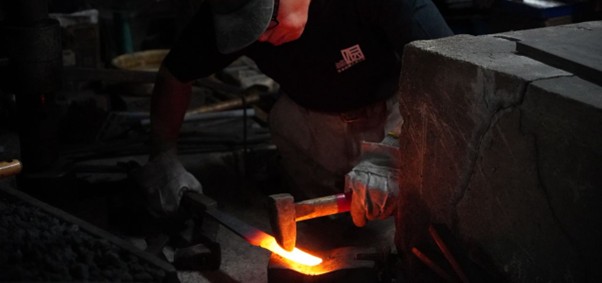
Itsuo Doi still forge his knives while already retirement age
Itsuo Doi grew up in the presence of this philosophy. Watching steel move under controlled heat, he learned that forging was not about power, but restraint. When he eventually took his place at the anvil, he did not try to surpass his father by doing more; he honored him by doing no more than necessary. Nearly fifty years later, that mindset still defines his work. Doi-san heats his steel only until it is willing to move. Nothing beyond that. Each strike of the hammer is deliberate, each reheating carefully judged. He understands that excessive heat enlarges carbides and weakens the blade from within. By resisting the temptation to rush, he produces knives that are both keen and trustworthy, blades that feel alive yet controlled in the hand.
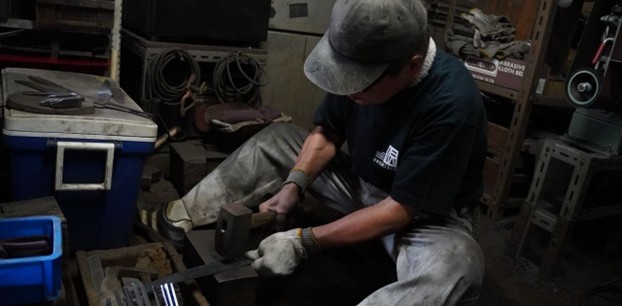
The hammer that Doi san use is really heavy
For much of his career, Itsuo Doi remained devoted to single-bevel knives, the traditional tools of highly trained Japanese chefs. These blades demanded precision, and Doi-san was never interested in shortcuts. Yet tradition, when guided properly, can evolve. It was through his relationship with Sakai Takayuki that a new chapter opened. Encouraged to explore double-bevel knives, Doi-san brought the same uncompromising forging philosophy into a form that would reach a wider audience. From this collaboration, the Homura series was born. Homura, an old word for flame, captures the quiet intensity behind these knives. The character 焔 engraved on the blade is not decorative; it is symbolic. It represents the controlled fire of the forge, the heat restrained rather than unleashed. These blades are powerful, but never aggressive. Their final character is shaped not only by Doi-san’s forging, but also by the Yamatsuka family, Sakai Takayuki’s master sharpeners. Working together across generations, the family refines each blade with deep understanding and unity. Their sharpening gives the knife its voice, transforming raw potential into balance, clarity, and breathtaking cutting performance.
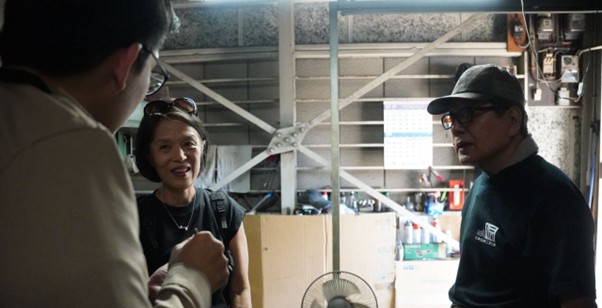
We able to ask about the knife process with Yasuko san as translator
In the kitchen, Itsuo Doi’s knives reveal their true nature. They hold their edge with quiet confidence, glide through ingredients without protest, and offer feedback that experienced hands immediately recognize. They are not flashy tools designed to impress at first glance. Instead, they earn respect over time through consistency, durability, and an edge that seems to deepen with use. Each knife is a continuation of a conversation begun by his father, one spoken not in words, but in steel, fire, and restraint.
When we visited Doi-san, it felt like stepping into the final chapter of a long and meaningful journey. Though he is nearing retirement, his presence is anything but fragile. His hands are steady, his posture strong, and his spirit firmly rooted in the forge that has shaped his life. There is a quiet sense that time is beginning to catch up, and with it, the understanding that the knives he continues to make will only grow rarer and more valuable. During our visit, he surprised us with a deeply personal gesture, a single-bevel petty knife he had forged but not yet polished, given to us as a souvenir. Raw and unfinished, it carried the marks of the hammer and the warmth of the forge, a powerful reminder that what we were holding was not just steel, but a living piece of his legacy.
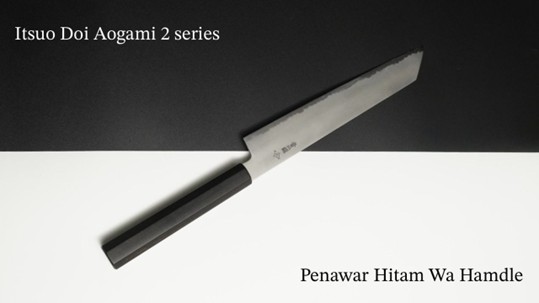
Our Itsuo Doi knives will be pair with Penawar Hitam Wa handle